Fellows' affiliations at the time of their fellowships are listed below.
Caroline Acker (2003-04),
associate professor of history, Carnegie Mellon University
Caroline
Acker's research interests stem from her experiences as
a historian of medicine and as a public health advocate.
The founder of several needle exchange programs, Acker is
well informed about the transmission of HIV among street
drug users. Her fellowship project will reconstruct how
injection drug users have used syringes and other drug paraphernalia
since 1900, with an emphasis on how knowledge about how
to use this equipment was transmitted among networks of
injection drug users. Her work adds the experiences of illicit
drug users to an area of medical technology where prior
historical attention has focused solely on medical use.
Aaron Alcorn (2005-06), Ph.D. candidate, Case
Western Reserve University
Alcorn’s dissertation on model building explores the
roles that model airplanes played in creating and distributing
knowledge about flight in the United States during the twentieth
century. Alcorn seeks to examine the potential connections
between childhood model building and aeronautical engineering
within the broader context of a culture of “inventive
boyhood” in the early twentieth century. Alcorn will
use a wide variety of museum collections, including patent
models, hobbyist literature and the recently acquired Revel
collection to explore the links between professional practice
and popular culture.
Harry Allen (2004-05), freelance journalist
Harry Allen is interested in end-user modifications
of computer games as a form of customization or tinkering.
In his project, “Architecture and Design in Quake
III Arena: Maps & Levels,” Allen compares modifications
of computer software by gamers to other innovative endeavors,
such as hot rod customization and jazz improvisation. Allen
hopes to identify similarities among these seemingly unrelated
activities to better understand human efforts to create
unique and individualized forms.
Regina Blaszczyk (1999-2000), assistant professor of
history and American studies, Boston University
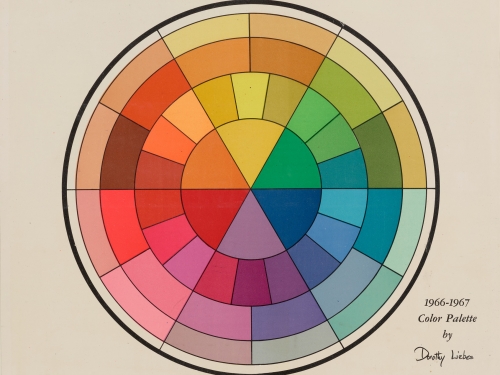
Today,
Americans are accustomed to a startlingly bright material
world; fashion hues change with the seasons and coordinate
with all other colors. Yet few stop to ponder the roots
of the "color revolution" that transformed material
life in the 20th century. Not surprisingly, the quest for
fashion colors that were both predictable and playful originated
in American industry during the heyday of scientific management
and mass production during the 1910s-and, ironically, during
the golden age of batch production. At the moment when Frederick
W. Taylor's followers pressed for "one best way,"
American consumers accustomed to visual variety demanded
appliances, clothing, and automobiles that expressed individuality
and personal taste. By the post-World War II era, American
manufacturers and retailers fully recognized how to use
color for gaining competitive advantage as a mechanism for
adding novelty to otherwise uniform products. Remarkably
adaptive, color provided designers with the means for reconciling
consumers' desires for differentiation with manufacturers'
interest in standardization.
During her fellowship at the Lemelson Center, Regina Blaszczyk
will be working on a book on "The Color Revolution"
that explores the pull and tug between these contradictory
strains in American business and culture. Questions about
the relationships among design, innovation, and consumerism
rest at the heart of her project. Using artifacts, company
records, trade journals, personal papers, oral histories,
and organizational archives as primary sources, she examines
the creation and standardization of new colors as inventive
processes, considers the cultural tensions embodied in color,
and looks at forecasting as an innovative task.
Andrew Bozanic (2008), Ph.D. candidate, Hagley
Program, University of Delaware
Bozanic’s dissertation examines the interplay between
makers and users in the social construction of the acoustic
guitar in the 20th century, from innovative production techniques
and designs to inventive new playing styles. From 1880 to
1970, American manufacturers and musicians influenced the
composition, style, and sound of acoustic instruments, resulting
in a uniquely flexible and distinctly American guitar that
was easy to play, hard to break, and extremely portable.
In addition to the museum’s collection of musical
instruments, Bozanic will also examine the business records
of guitar manufacturers, periodicals, sheet music, oral
histories, and sound recordings.
Richard Candee (1996-97), professor of American and
New England studies and director of the Preservation Studies
Program at Boston University
Candee holds doctorates
from the University of Pennsylvania and the University of
York, England, and has written extensively on New England
industry, architecture, and historic preservation. As a
Lemelson Center Fellow, Candee will produce a journal article
on Invention and the Mechanization of 19th Century American
Knitting using the patent model, costume, and trade catalogue
resources at the National Museum of American History.
W. Bernard Carlson (2005-06), associate professor,
University of Virginia
Carlson is preparing a book-length biography of American
inventor Nikola Tesla which explores the role of persuasion
in the inventive process. Successful inventors, Carlson
argues, go beyond the act of invention by persuading others
to publicize, invest in, and use a new technology. He seeks
to understand precisely how these inventor-entrepreneurs
use demonstrations, prototypes, photographs, and interviews
to connect new devices with themes and values in popular
culture. Carlson will use Tesla-related artifacts in the
electricity collections, 19th-century electrical books and
Tesla correspondence in the Dibner Library, and the Swezey
collection in the Archives Center to explore Tesla’s
work. He will also make use of the personal papers of other
inventors in the collections to more broadly understand
how inventors promote their work.
Hyungsub Choi (2006-07), Ph.D. candidate, Johns
Hopkins University
Choi is looking at the creation and circulation of transistor
manufacturing knowledge in the midst of national innovation
systems that were undergoing extensive post-war transformation
in the U.S. and Japan. Choi argues that the technical challenge
of mass producing a new technology, in combination with
perceived national security needs, facilitated a rearrangement
of the U.S. and Japanese political economy. In addition
to the museum’s collections of early transistors,
Choi will also make use of the “chip” collection,
and the Integrated Circuit Engineering Corporation records
in the Archives Center.
Joseph Corn (2006-07), senior lecturer, Stanford
University
Corn has received both Lemelson and Smithsonian fellowships
to conduct research for his book User-Unfriendly: Consumer
Struggles with Personal Technology, which explores
the difficulties consumers have had buying, learning to
operate, and in general understanding and living with complex
technologies. He will focus on three crucial devices: the
sewing machine, the automobile, and the personal computer,
which have each influenced American life in very different
ways. It is the sewing machine, one of the first technologies
to enter the home that came with tools and an owner’s
manual, that Corn intends to focus on during his Lemelson
fellowship. He will examine the museum’s collection
of sewing machines, as well as trade literature and instruction
manuals in the Archives Center.
Timothy Davis (1998-99), historian, Historic
American Engineering Record, National Park Service
National parks and automobiles, two of America's most
popular cultural icons, have been inextricably related throughout
the history of American park development. But the relationship
of the road to the park has been filled with tension. How
do we protect our national parks while providing access
to the people who support them? Can nature and culture co-exist?
Are nature reserves really "natural" if visitors
can drive to and through them?
The creative solutions of America's park road designers
to these questions and challenges is the focus of Davis's
research. He shows how park road development has evolved
over time, and demonstrates that change and innovation are
as much a part of the national park experience as the seemingly
constant and immutable natural landscape.
Gregory Dreicer (1997-98), independent curator and historian
Dreicer
is exploring the interrelationships that advanced a landmark
development in modern history--the invention of the frame
structures that characterize our world. Dreicer presents
wooden and metal building systems as structural networks
whose creation and development were part of larger networks
of invention, transportation, and industrialization. The
lattice, a type of truss bridge, is featured in the scholarly
book, exhibition, and interactive materials that comprise
his project.
Samuel Dodd (2011), Ph.D. candidate, Architectural History and Theory, University of Texas, Austin
Dodd’s dissertation examines how professional architects and the American construction industry used the emerging medium of television to advance their socio-political aims and promote a popular ideology of modern American building and architecture. Dodd closely examined the National Association of Manufacturers’ Industry on Parade film series, a syndicated public affairs television program produced by NAM as "a pictorial review of events in business and industry." Dodd specifically focused on 56 episodes that highlighted the manufacture of building materials, the construction and building trades, domestic and suburban life, and general architecture. By closely examining and comparing the various episodes for their visual format, narrative structure, cultural references, and televisual techniques, Dodd found that the Industry on Parade series helped empower viewers with information, while “humanizing” American industry. As such, the series served as an important antecedent for television channels such as the DIY Network and HGTV, and programs like How It's Made.
Patrick Feaster (2011), instructor, Folklore and Ethnomusicology, Indiana University
Feaster worked closely with Division of Work and Industry curator Carlene Stephens to study and catalog some of the NMAH’s early experimental sound recordings made by Alexander Graham Bell, Emile Berliner and Charles Sumner Tainter in the 1880s and 1890s. Feaster also consulted the Tainter and William J. Hammer collections in the NMAH Archives Center, as well as the Berliner and Bell papers at the Library of Congress. Feaster methodically linked his physical examination of the recording media with corresponding laboratory notes and journal entries he found in the inventors’ written archival records. Additionally, using sophisticated optical techniques, Feaster attempted to recover, playback, and interpret some of these early recordings without touching or damaging the original cylinders and discs. His work will eventually result in a published, comprehensive discography of the NMAH’s approximately 400 recordings, which will serve a resource for future researchers.
Kathleen Franz (1999-2000), Brown University
"There
was this about a Model T," wrote E.B. White in 1936,
"the purchaser never regarded his purchase as a complete,
finished product. When you bought a Ford, you figured you
had a start-a vibrant, spirited framework to which could
be screwed an almost limitless assortment of decorative
and functional hardware. Driving away from the agency É
you were already full of creative worry." In his sentimental
eulogy for the archetype of Fordist production, White demonstrated
that automotive design was not completely determined at
the point of production, nor did it exclude users. Between
1915 and the early years of the Depression, travelers often
became amateur inventors as they tinkered with the bodies
of their automobiles.
Kathleen Franz used her time as a Lemelson Fellow to
expand her research on middle-class tinkerers who patented
their ideas for automotive accessories between 1910 and
1936. Her project interpreted playful invention as tinkering,
which was both a leisure time activity, something middle-class
Americans did for pleasure as well as a form of creative
play that allowed consumers to redesign the car to fit their
needs as travelers. Franz's research built on her dissertation
and resulted in the book Tinkering: Consumers Reinvent the Early Automobile (2005).
Daniel Freund (2005-06), Ph.D. candidate, Columbia
University
Freund’s dissertation examines the commodification
of natural light in American cities in the early twentieth
century, at a time when concerns that air pollution and
the trend towards skyscrapers were negatively affecting
the health and well being of city dwellers, especially children.
While at the Lemelson Center, Freund will explore technologies
invented to counter the perceived problems of lack of sunlight,
including special window glass, light therapy, and vitamin-D
fortified foods. He will make use of a wide variety of museum
collections, from lamps in the electricity collections to
advertising and the Nela Park (General Electric) archival
records, to name a few.
Sarah Gillespie (2004-05), Ph.D. candidate,
CUNY Graduate Center
While Samuel Morse is recognized as an important
19th century American painter and inventor of the telegraph,
Sarah Gillespie seeks to explore his contributions to early
American photography. Morse was instrumental in introducing
the process of daguerreotypy in the United States soon after
the invention was announced in France in 1839. Gillespie
will study the Morse and Draper collections housed in the
museum’s Photo History division to document Morse’s
technical innovations as well as his artistic uses of photography.
Charles Gillmor (2004-05), professor of history
of science, Wesleyan University
Charles Gillmor
seeks to document the life of Henry Middleton, amateur inventor
and student of nineteenth century physicist, James Clerk
Maxwell. A devotee of Victorian science born and raised
in South Carolina, Middleton applied for or received fifty
patents over his lifetime, for everything from a surveying
level to a flying machine. Gillmor’s study of Middleton’s
career as an amateur inventor and disciple of Darwin offers
perspective on the role of science in the American south
after the Civil War.
Raiford Guins (2010), assistant professor, State
University of New York, Stony Brook
Guins research explores the study of video/computer game
history with special emphasis on the methods necessary for
preservation of computer games. Guins used the Ralph Baer
Papers and related artifacts, as a specific case study for
his forthcoming book project Arcadeology: Excavations in
Video Game History, Memory, and Preservation. Specifically,
he examines early models of TV games and components prior
to the production and marketing of Baer’s invention of the
Odyssey for Magnavox. Guins also explores how institutional
archives illustrate how documentation strategies and curatorial
models are employed on complex artifacts like video/computer games.
Aimi Hamraie (2012-13), Ph.D. candidate, Women’s, Gender, & Sexuality Studies, Emory University
Hamraie explored the role of scientific knowledge production in the invention of assistive technologies and the emergence of the Universal Design (UD) movement. She examined several collections, including the Accessible Snowboard Collection, the Van Phillips Video Oral History and Papers, the Safko International, Inc. Records, and the Jose L. Hernandez-Rebollar Innovative Lives Presentation. She also worked with the Smithsonian Accessibility Office to understand how universal design considerations have been built into past exhibitions and the Museum itself.
Kristen Haring (2000-01), Ph.D. candidate, History of
Science, Harvard University
"Amateurs matter in
technology," asserts Kristen Haring. "Engineers
and big business do not simply hand down innovations to
the rest of us. Important technical ideas arise from weekend
tinkering in basement workshops." Haring's dissertation-in-progress
focuses on the work of these anonymous inventors in the
field of amateur, or "ham," radio. While amateur
radio enthusiasts embraced the image of great inventors
struggling alone in workshops until the "eureka"
moment arrived, most ham operators were, in fact, unconventional
inventors. In contrast to the secrecy involved in the patent
process, the culture of the hobby dictated sharing of knowledge;
amateur radio inventors typically published their ideas
in ham radio magazines. Making extensive use of the archival
and artifact collections of the Museum, Haring hopes to
uncover the legacy of achievement left by the hundreds of
amateur inventors who disappeared behind this veil of modesty.
Kathryn Henderson (1998-99), assistant professor of
sociology, Texas A&M University
Traditional cultures
throughout the world have used straw, grasses, and reeds,
sometimes combined with earth and timber, to create durable
shelter. But until recently the method was considered by
many to be primitive and unattractive.
Not so any more. Henderson is showing that straw-bale building--a
cost-efficient and environmentally friendly method--is making
a comeback with both grassroots home builders and progressive
contractors and architects.
The roots of straw-bale construction are in the invention
of horsepowered mechanical hay balers in the U.S. in the
late 1800s. They afforded timber-poor Nebraska pioneers
a material for building modest homes from resources at hand.
Later, builders showed the flexibility of straw-bale building
by developing different styles. Today, builders in Texas
demonstrate that straw-bale construction not only provides
excellent insulation, but creates new communities as people
gather to raise the straw-bale wall of new structures. Henderson
has done extensive ethnographic field work in central Texas
with contemporary straw-bale builders as well as research
in the Museum's collections on the development of hay-baling
technology.
Dean Herrin (1997-98), historian, Historic American
Engineering Record, National Park Service
Herrin is writing
several journal articles on Montgomery Meigs, celebrated
Quartermaster General of the Union Army during the Civil
War. Meigs was a skilled engineer with experience in the
fields of architecture, invention, art, science, and government.
Herrin explores the themes of invention and innovation in
Meigs's career, especially as they pertain to the diverse
sources of engineering inventiveness, the role of engineering
"style," and the collaborative nature of invention.
Eric Hintz (2007), Ph.D. candidate, University of Pennsylvania
Hintz’s dissertation examined the changing fortunes
of independent American inventors during the rise of corporate
R&D in the first half of the twentieth century. With
corporate R&D on the rise, the world of independent
inventors was beginning to change. Yet historical patent
data shows that individual inventors continued to outpace
corporate labs in numbers of patents granted well into the
1930s. Hintz explored a wide variety of independent
inventors’ papers housed in the Museum’s Archives
Center to find out how inventors reacted and adapted to
the emergence of industrial research as a competitive threat,
how they attempted to survive economically, and how they
were impacted by larger economic forces propelled by two
world wars and the New Deal.
Matthew Hockenberry (2012-2013), Ph.D. candidate, Media, Culture, and Communication, New York University, and Co-Founder, SourceMap.com
Hockenberry researched and mapped the global supply chains used in the manufacture of telegraph and telephone technologies from approximately 1876-1926. He examined several collections, including the Western Union Telegraph Company Records, the Anglo-American Telegraph Company, Ltd. Records, and the papers of Western Electric Manufacturing Co. co-founder, Elisha Gray.
Roger Horowitz (2000-01), associate director, Center
for the History of Business, Technology, and Society, Hagley
Museum and Library
Roger Horowitz is interested in the interaction of technological
innovation and popular consumption habits as it relates
to our daily diet. Following on his earlier work in labor
history and the meatpacking industry, Horowitz is completing
a book on "Meat: Technology, Industry, and Taste in
America" during his Lemelson Fellowship. The book,
under contract to Johns Hopkins University Press, focuses
on the mobilization of technology, labor, and capital that
made meat an accustomed part of the American diet. The book's
central issue is the special character of meat as a perishable
artifact "created" by slaughtering animals of
irregular sizes. Developing the apparatus for killing, preserving,
and disseminating meat entailed massive capital investment
by business organizations, the labors of tens of thousands
of workers, and the creation of machinery to speed production
and distribution. "Making meat," however, always
was tightly linked to the ways Americans obtained and ate
meat. Processing technologies and entrepreneurial initiatives
evolved in close conjunction with food consumption practices
and Americans' insistence on obtaining wholesome and nutritious
meat that conformed to individual and family needs.
Andrew Hurle (2009), Ph.D. candidate, College of Fine Arts, University of New South Wales
Hurle's dissertation examines the technical innovations of mechanical drawing and machine engraving devices and
how they were used to create the ornamental linear designs on nineteenth century American currency which have
since been used to secure paper money against counterfeit. He is also interested in how the visual appearance
of financial and security documents communicate tangible value, giving people faith and confidence in everyday
monetary transactions. In addition to his historical research, Hurle intends to create a body of artistic
work in conjunction with the Centre for Fine Print Research in Bristol, England which complements and
forms a dialog with his academic scholarship.
B. Zorina Khan (1997-98), assistant professor of economics, Bowdoin College
Khan is writing a book that assesses the nature and
determinants of patenting and inventive activity in the
United States between 1790 and 1865. Khan examines the role
of the patent system in influencing thedemocratic nature
of invention in the United States in comparison to other
countries; demonstrates the system's flexibility and responsiveness
to external change; and evaluates whether the rate and direction
of inventive activity were measurably altered during the
war years.
Shane Landrum (2008), Ph.D. candidate, Brandeis
University
Landrum will use his fellowship to examine the punchcard
tabulation equipment designed by inventor Herman Hollerith
and his major competitor James Powers in the late 19th century.
These machines enabled American government and business
to summarize complicated data quickly and affordably, making
the United States the first country in the world to use
machines for calculating public health statistics and census
data. This project is part of Landrum’s dissertation,
which focuses on the development of American birth registration
systems.
Stuart W. Leslie (1996-97), professor of history of
science, medicine and technology, Johns Hopkins University
Leslie's
publications include The Cold War and American Science (1993)
and other studies of post-World War II science research.
Building on his contributions as a panelist at the Lemelson
Center's "The Inventor and the Innovative Society"
symposium in November 1995, Leslie will write two articles
during his tenure as a Fellow, studying the successes and
failures of New York state's science and technology programs.
His research will give insight into designing future programs
that foster innovation and high-tech development.
Hallie Lieberman (2012-13), Ph.D. candidate, Mass Communication, University of Wisconsin, Madison
Lieberman studied the technological history and social impact of sex toys and sexual aids. She explored familiar collections in new ways--for example, she examined the trade catalogs of the B.F. Goodrich rubber company for information on condoms (rather than tires) and the catalogs of the Hamilton Beach appliance company for information on vibrators (not toasters or blenders). She also examined the museum’s HIV/AIDS collections and long runs of various periodicals to track the socio-cultural impact of sexual toys and devices.
Joris Mercelis (2010), Ph.D. candidate, History, Ghent University
Mercelis’s dissertation examines the career of Belgian-American chemist,
inventor, and entrepreneur, Dr. Leo H. Baekeland, best known for inventing
velox film and his namesake Bakelite plastics. Mercelis primarily consulted
the NMAH’s collection of Baekeland papers, but also examined several
collections that documented the diffusion of Bakelite products through several
industries; these included the J. Harry DuBois Collection on the History of
Plastic, the Celluloid Corporation Records, the Grace Jeffers Collection of
Formica Materials, the Western Union Telegraph Company Records, and the
Warshaw Collection of Business Americana. Mercelis explored Baekeland’s
career from several analytical angles, including his experience as an
immigrant and international businessman; his commitment to science-based
industrial research; his entrepreneurial style and commercial strategy; and
his approach to intellectual property.
Jeffrey Matsuura (2007), counsel, Alliance Law
Group
Matsuura explores the development of trans-Atlantic cables
at the Anglo-American Telegraph Company as a case study
on the role of innovation in large, complex, international
ventures. His examination is intended to identify the legal
and commercial strategies applied by the Anglo-American
Telegraph Company in order to facilitate the development,
protection, and use of the intellectual property, equipment,
systems, personnel, and financial resources necessary to
complete the first trans-Atlantic undersea communications
cable system. Matsuura seeks to compare his analysis of
these historical sources to the strategies applied by modern
companies engaged in major international projects that relay
on innovative new technologies today.
Jakob Messerli (2001-02), director, Deutsches Uhrenmuseum
The introduction of the "American System"
of mass production in the American clockmaking industry
at the beginning of the 19th century is accepted as an important
step, not only for the mass-production of timepieces, but
for industrial development in general. German clockmaking
in the Black Forest had long-dominated the global market
for clocks, but was slow to adopt the "American System."
Surprisingly, little is known about the relationship between
the American clock industry and German clockmaking in the
Black Forest during this period. In this research project,
Jakob Messerli plans a comparative study of Black Forest
and American wooden-movement clocks. Who were the German
clock peddlers who came to America? What do Black Forest
and American wooden clock movements have in common? What
effect did the "American System" have on clockmaking
in the Black Forest? These are the questions Messerli seeks
to answer during his fellowship. His research will contribute
to an upcoming exhibit on this theme at the Deutsches Uhrenmuseum.
Mara Mills (2006-07), Ph.D. candidate, Harvard
University
Mills's dissertation analyzes the contributions of deaf
and hard-of-hearing people to the development of technologies
for amplification, sound inscription, and speech synthesis.
Looking specifically at the hearing aid, sound spectrography,
and speaking automata, she both explores the experiences
of disabled individuals and argues for their central influence
on information theory and transistorization. Mills has discovered
that, once deaf people were understood to be “educable,”
they began serving as models for communication technologies.
In turn, she argues, new technologies influenced how scientists
perceived human anatomy. For example, the invention of telephony
led scientists to think of the ear as productive and amplifying,
rather than as a passive recording device. Mills will examine
the museum’s speech synthesis and hearing device collections.
Cyrus Mody (2002-03), Ph.D. candidate in the Science
and Technology Studies Department, Cornell University
Cyrus
Mody is interested in the link between measurement standards
(metrology) and instrumentation. The case study for his
dissertation focuses on the organizational cultures that
developed around the invention and use of the scanning probe
microscope. Studying the development of these instruments
at corporate research labs, academic institutions, and startup
companies, Mody traces how two vastly different cultures
of scanned microscope experimentation and innovation emerged
in the 1980s. He findsone culture that evolved from traditional
surface science (primarily at IBM and Bell Labs), and another
that was cobbled together from researchers on the west coast
(Stanford, UC Santa Barbara) who were interested in inventing
and propagating new instruments. Together these cultures
set the basis for what would count as a good microscope,
how to build them, and how to make the results obtained
from these new instruments credible to a wider audience.
Simone Mueller (2010), Ph.D. candidate, Free University, Berlin
Mueller’s work explores the interaction of the global and the local sphere in the late 19th and early 20th centuries, using the Atlantic cable station at Heart’s Content, Newfoundland as an example. Mueller analyzes how globalization, as it is represented in the invention of the submarine telegraphs and their communication implications, affected people socially and culturally on a local level and vice versa. Her study concerns itself with the interaction of Atlantic cable station operators, local residents, and local landline operators and attempts to solve the seeming contradiction of Heart’s Content being at the periphery of civilization while also at the heart of global communication.
Fred Nadis (2007), associate editor, ABC-Clio
Nadis is studying the engineering and design innovators
behind America’s early rollercoasters and theme rides
beginning in the nineteenth century. His project focuses
on two separate streams of innovation that shared a common
source in nineteenth-century “scenic railways”--rides
in which passengers traveled through artificially-enhanced
landscapes. These scenic railways led to both to modern-day
theme rides and high speed rollercoasters. While the technology
of these rides was grounded in multiple patents, the engineers
who designed them were remarkably creative, often improvising
the design of the ride on site. The legacy of these inventors
remains an important vernacular architectural and cultural
form.
Robert O’Harrow (2012-2013), author and columnist, The Washington Post
O’Harrow performed research for his forthcoming popular biography of General Montgomery C. Meigs entitled A Soul on Fire (to be publshed by Free Press, an imprint of Simon & Schuster). Besides his critical role as quartermaster general of the Union Army during the Civil War (and as a Smithsonian regent), Meigs was also the engineer responsible for several Washington, D.C., landmarks, including the Potomac River aqueduct that still provides water to the district, the Capitol dome, and the old Pension Bureau building, which now houses the National Building Museum.
Amy Ogata (2005-06), associate professor, Bard
Graduate Center
Looking at the nature of childhood in the post-WWII period,
Ogata is writing a book that will focus on how the concept
of creativity emerged as a dominant social value in the
1950s and '60s, influencing a vast array of educational
and play spaces, toys, books, and other amusements designed
to stimulate intelligence. Utilizing a variety of museum
collections, from childhood toys in the Home and Community
Life collections to archival resources such as the Binney
and Smith (Crayola) papers, Ogata will examine how the idea
of creativity emerged in the mid-twentieth century and how
it became inscribed upon postwar childhood, contributing
to our understanding of creativity as a historical subject.
Ruth Oldenziel (1996-97), associate professor of technology,
gender and representation at the University of Amsterdam
Oldenziel is the author of numerous articles, papers,
and book reviews published in the U.S. and the Netherlands
and is founder and president of the Society for Gender and
Technology. At the Lemelson Center, Oldenziel will complete
several articles for a book, Body by Fisher: The Fisher
Body Company, its Craftsman's Guild and Their Models, 1920-1970,
based on extensive primary source materials in the collections
of the Smithsonian.
Heinrich Schwarz (2000-01), Ph.D. candidate, Program
in Science, Technology, and Society, Massachusetts Institute
of Technology
Much attention, in both popular media and
academic disciplines, is paid today to the shifting nature
of work in the context of a changing economy, technological
advances, and a general process of globalization. The perceived
move towards a post-industrial, information-based, and networked
society, populated by technologically-supported knowledge
workers, gives rise to images of working nomads, constantly
on the move as part of virtual offices or organizations
where space and time no longer matter. In his dissertation-in-progress,
Heinrich Schwarz is investigating the changes in office
work as they are related to changes in the layout and design
of work environments, and in particular, of offices. Through
this lens, he is examining the interrelation of social,
spatial, and technological reorganizations of office work:
how information and communication technologies, the organization
of workspaces and workplaces, and the social structure of
office work mutually affect each other. The result of Schwarz's
research will be a better understanding of the current trend
towards more mobile, flexible, and virtual forms of work--and
what that means for the workers involved.
Ben Shackleford (2001-02), Ph.D. candidate, Georgia
Institute of Technology
"The technologists who created
stock cars labored in virtual obscurity," explains
Ben Shackleford. "My research seeks to uncover the
remarkable exploits of this anonymous community of tinkerers
and inventors who structured the course of innovation and
diffusion that governs competition in American stock car
racing." Shackleford's dissertation-in-progress focuses
on the development of stock car technology through the diffusion
of innovation among mechanics. In spite of the secrecy surrounding
innovations in stock car technology that often provided
a competitive advantage, Shackleford's research shows that
this knowledge easily spread throughout the racing community.
During his fellowship, Shackleford will use both enthusiast
literature and the stock cars themselves to document how
technological knowledge was transferred among skilled mechanics.
His research will contribute to the upcoming joint Smithsonian
and Atlanta History Center exhibit entitled "Speed
and Spirit."
Susan Sherwood (2003-04), independent scholar and executive
director, Center for Technology and Innovation, Binghamton,
NY
Working with the Broome County Historical Society
in Binghamton, New York, Susan Sherwood seeks to document
the industrial history of New York State's "Southern
Tier." She is studying the development of photographic
and chemical technologies at Ansco-Afga-GAF in the 20th
century. Her analysis of the GAF collections at the Smithsonian
and the Broome County Historical Society is informed by
her oral history interviews with retired chemists from the
company. By tracking how methods of innovation developed
over time through changing economic conditions, Sherwood's
research promises to contribute to our knowledge of how
innovation "hot spots" develop in specific geographic
regions.
Bruce Sinclair (1996-97), professor emeritus of history
of technology, Georgia Institute of Technology
Sinclair came to the Lemelson Center to work on a book
titled Technology and the African American Experience: Needs
and Opportunities for Study. Sinclair earned his Ph.D. from
the Case Institute of Technology and has written many books,
articles, and book reviews on American technology and technical
education, including New Perspectives on Technology and
American Culture (1986). In 1995 Sinclair was awarded the
Da Vinci Medal by the Society for the History of Technology.
Dominique Tobbell (2006-07), Ph.D. candidate,
University of Pennsylvania
Tobbell is writing a dissertation exploring the relationship
between industry, academic institutions, and government
in the creation of a research and political culture that
promoted private drug development in the last half of the
20th century. Tobbell argues that the forging of these cultures
depended on the maintenance of knowledge networks between
industrial, academic, and clinical researchers, and political
networks between industry, universities and the government.
She will examine the records of several pharmaceutical companies
in the Archives Center, including Sterling Drug, Inc., Norwich
Eaton Pharmaceuticals, and Syntex.
Thorin Tritter (2001-02), adjunct lecturer, La Guardia
Community College
Thorin Tritter is interested in technological changes
in the newspaper industry in New York. Tritter's research
challenges the common image that the newspaper industry
has been slow to modernize or adapt to change. He shows
that, from the penny press revolution in the 1830s to the
rise of the modern newspaper 100 years later, the newspaper
industry in New York continually sought ways to increase
production and reduce costs through new machinery. During
his fellowship, Tritter will revise his dissertation for
publication to incorporate more detailed information about
the role of technology in newspaper printing, specifically
printing presses and type-setting machinery. He will explore
how these key inventions were made and what effects the
new machinery had on the industry and its workforce. "These
new machines did more than just alter one industry,"
Tritter asserts, "they changed the way Americans learned
about the world and helped create an American culture."
Adelheid Voskuhl (2012-2013), associate professor, History of Science, Harvard University
Voskuhl investigated several emerging philosophies of technology as described in the transatlantic exchanges of German-American engineers and technological elites from 1870 to 1930. Voskuhl examined the Museum’s extensive collection of both German-language and American technical trade journals, and several manuscript collections, including the S. Colum Gilfillan Papers and the Frank and Lillian Gilbreth Collection.
Gregory Wickliff (2010), associate professor, University of North Carolina, Charlotte
Wickliff’s research examines John William Draper (1811-1882) and his innovative contributions to daguerreotypy and early photography as well as reflecting upon the work of Draper’s son, Henry (1837-1882), in astrophotography and to a lesser extent photomicrography. Wickliff documents the full range of Draper’s early experiments in photography to establish more clearly the importance of Draper’s early innovations, and their significance in the evolution of thought about the science and technology of photography. His forthcoming book is titled, Enlightened Arguments: Photography and Rhetoric in Nineteenth-Century American Science and Technology.
Steven Wilf (2012), professor and associate dean, University of Connecticut Law School
Wilf, a legal historian, conducted research for his forthcoming book, tentatively titled: Intellectual Property Law in America: A Legal and Cultural History. The book traces the history of American intellectual property law from its beginnings in the 18th century through the digital age and describes how patent, copyright, and trademark laws serve to prompt, direct, or even constrain innovation. Wilf examined legal documents and court records in several of the museum’s invention-oriented collections, including the Telescoping Shopping Cart Collection; the Eisler Engineering Company Records; the Serge A. Scherbatskoy Papers; the Arthur Ehrat Papers; and the Leo H. Baekeland Papers.
Sara "Bess" Williamson (2009), Ph.D. candidate, History of American Civilization,
University of Delaware
Williamson is interested in how changing ideas about disability and rights in the last half
of the twentieth century played a role in making products and spaces more accessible.
She posits that during this time disability rights advocates linked the accessibility of
objects and environments to the entitlements of citizenship. An awareness of potential
disabled users has inspired new designs and features with broader applications and appeal,
pointing to the role of political change in the creative process. During her fellowship,
Williamson will examine museum collections of assistive technologies, such as wheelchairs
and prostheses, and materials related to the universal design movement which aims for the
ideal design for the broadest spectrum of users.
Damon Yarnell (2008), Ph.D. candidate, University
of Pennsylvania
Yarnell’s research looks at an often-overlooked aspect
of mass production at the Ford Motor Company in the early
20th century—the role of purchasing agents in the
company’s system of procurement, quality control,
inventory, shipping, and materials handling. Not only did
the assembly line facilitate an exceptional degree of internal
control and efficiency, supplier relationships were complex
and also essential for mass production. Yarnell will make
use of the museum’s extensive transportation history
collections, including trade catalogs, early automobile
periodicals, directories, and yearbooks, as well as the
records of the J&B Manufacturing Company and the Warshaw
Collection of Business Americana.
Tamar Zinguer (2002-03), Ph.D. candidate in the School
of Architecture, Princeton University
Tamar
Zinguer's dissertation investigates the ways in which construction
toys have related to architecture and to the built environment.
Case studies of four building toys-"Gifts" invented
by Friedrich Froebel; "Richter'Anchor stones"
by Otto and Gustav Lilienthal; "Erector Set" by
Andrew Gilbert; and the several toys by Charles and Ray
Eames-inform her research. These case studies show that
architecture became the conduit of scientific principles
from fields as diverse as mineralogy, zoology, chemistry,
and computer science. With different materials, the toys
have reflected new means of production, and conveyed their
authors' educational aims through the construction of space
combined with scientific principles. Drawing on an investigation
of these toy inventors and the artifacts themselves, Zinguer
seeks to illuminate how architectural playthings have reflected
stylistic inclinations, incorporated technological changes
in their systems of construction, and how these inventors
influenced and were influenced by theories of play and education. |